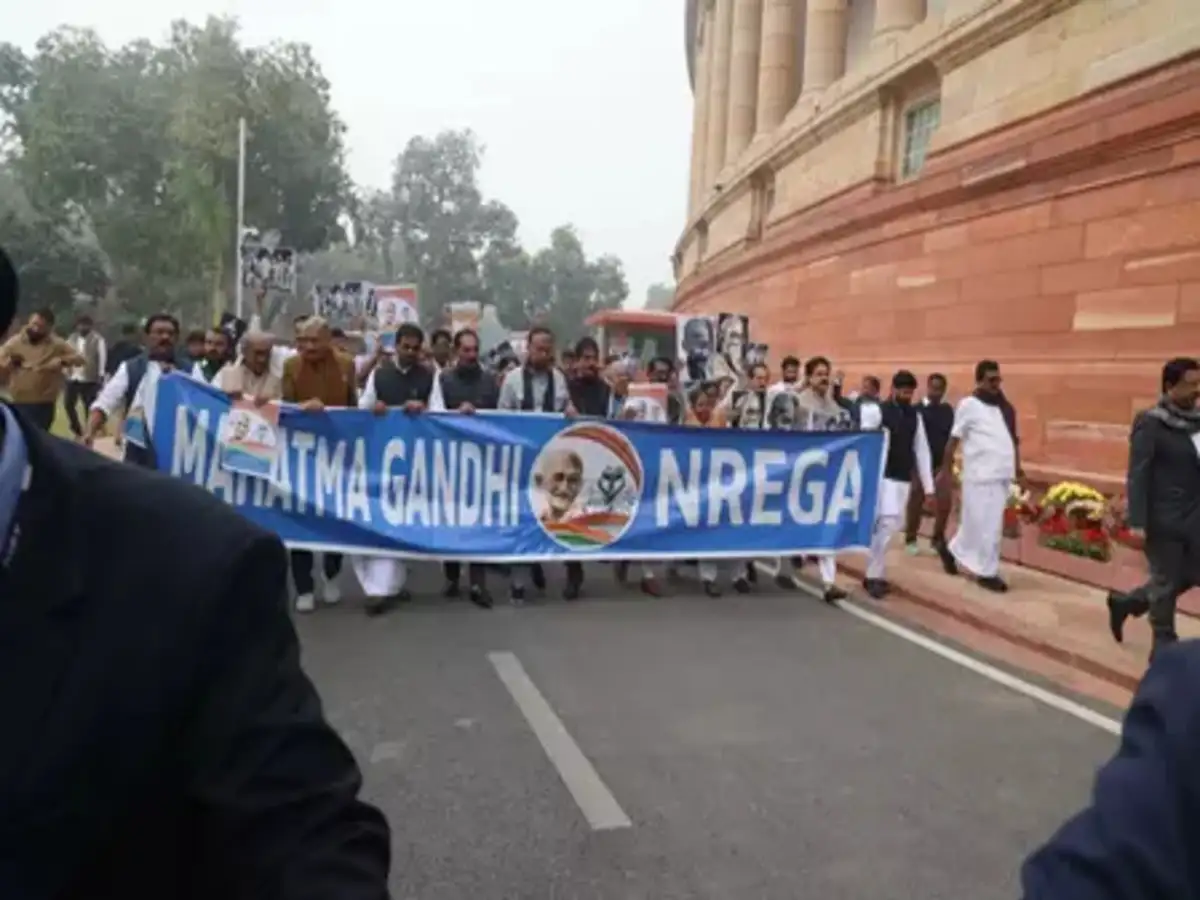
A major political controversy unfolded in the Lok Sabha after the government introduced a new rural employment law to replace the long-running Mahatma Gandhi National Rural Employment Guarantee Act (MGNREGA). The debate intensified when Union Rural Development Minister Shivraj Singh Chouhan claimed that Mahatma Gandhi’s name was added to the scheme by the Congress party with electoral intentions ahead of the 2009 general elections.
What the Government Proposed
The Lok Sabha passed the Viksit Bharat Guarantee for Rozgar and Ajeevika Mission (Gramin) Bill, 2025, which seeks to replace MGNREGA. Under the new legislation, rural households will be eligible for 125 days of guaranteed wage employment per year, an increase from the earlier 100 days. The government has described the bill as a forward-looking reform aimed at strengthening rural livelihoods and aligning employment schemes with India’s long-term development goals.
Shivraj Singh Chouhan’s Statement Sparks Row
During the debate, Shivraj Singh Chouhan stated that the original employment guarantee law did not carry Mahatma Gandhi’s name and that it was later added by the previous Congress-led government for political gains. He argued that the present government respects Mahatma Gandhi’s ideals through its actions and policies, not merely through naming conventions.
His remarks triggered strong reactions across the Opposition benches.
Opposition Protests in Parliament
Opposition parties accused the government of deliberately removing Mahatma Gandhi’s name from a scheme closely associated with rural welfare and social justice. Several MPs staged protests inside the Parliament complex, raising slogans and calling the move an attempt to erase Gandhi’s legacy from public policy.
Opposition leaders argued that MGNREGA symbolised the dignity of labour and economic security for millions of rural families, values deeply rooted in Gandhian philosophy. They questioned the need to rename the scheme when its core principles remained unchanged.
Political and Symbolic Implications
While the government maintains that the new law strengthens employment guarantees and modernises implementation, critics believe the renaming reflects a broader ideological shift. For them, the controversy goes beyond policy reform and touches upon the symbolic importance of Mahatma Gandhi in India’s democratic and welfare framework.
What Lies Ahead
With the bill now passed in the Lok Sabha, discussions are expected to continue both inside and outside Parliament. The rural employment programme remains a critical safety net for millions of households, and any changes to its structure or identity are likely to remain under close public scrutiny.
As India debates the balance between reform and legacy, the issue has once again highlighted how deeply intertwined policy, politics, and symbolism are in the country’s democratic process.