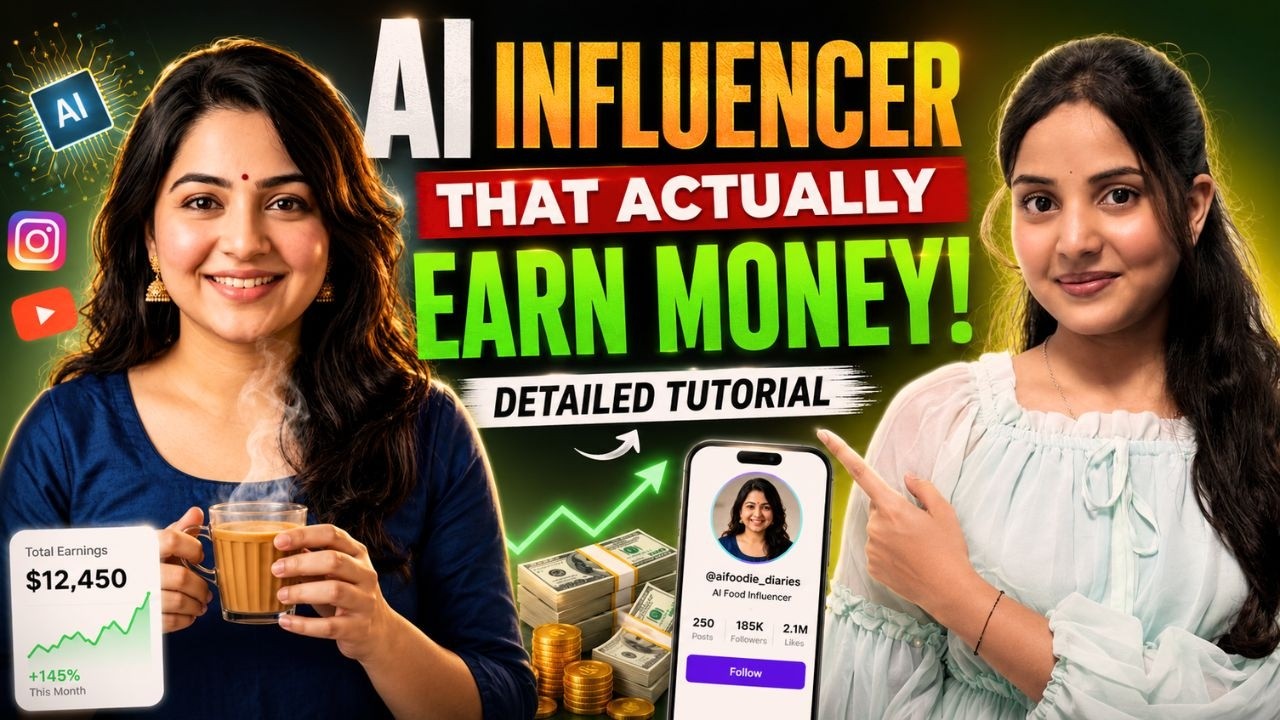
AI influencers are quickly becoming one of the most interesting applications of generative AI. With modern image and video generation tools, almost anyone can create a realistic virtual personality and publish content on Instagram, YouTube, Facebook, and other social platforms.
However, there is a major difference between creating an AI-generated character and building a successful AI influencer.
A visually attractive virtual model may generate curiosity, but long-term growth requires much more. The influencer needs a recognizable identity, clearly defined niche, consistent visual appearance, stable personality, voice, valuable content, and predictable posting strategy.
Let’s explore how to build an AI influencer from the ground up.
Why Most AI Influencers Fail
One of the biggest mistakes creators make is focusing almost entirely on appearance.
They generate an attractive AI character, create several random videos, and start posting.
But why should someone follow that character?
That’s the question you need to answer.
Successful human influencers usually have something audiences recognize them for. It could be their expertise, personality, storytelling, lifestyle, humor, or unique perspective.
Virtual influencers need the same foundation.
Your objective shouldn’t be:
“I want to create an AI girl.”
It should be something closer to:
“I want to create a young North Indian cooking creator who shares fast home recipes and practical cooking tips.”
The second idea already has an identity.
Define Your AI Influencer’s Niche
Start by selecting one main category.
For example:
Food → Indian Food → North Indian Cooking → Quick Home Recipes
Notice how each step becomes more specific.
This makes it easier to determine what videos to produce and also gives audiences a clear reason to follow the account.
The same strategy can be applied to almost any category.
Fashion → Affordable Indian Fashion → College Fashion
Fitness → Home Fitness → Beginner Workouts
Travel → India Travel → Budget Weekend Trips
Specific positioning makes the account easier to understand.
Develop a Real Personality
Next, create the influencer’s persona.
Give the character a name and decide what kind of personality they have.
Are they energetic?
Funny?
Calm?
Educational?
Luxury-focused?
Traditional?
Trendy?
For our hypothetical cooking creator, we could choose a young, energetic and trendy personality.
Then create a simple backstory explaining why the character shares cooking content.
You don’t need to write an entire novel.
Even a small amount of background can provide enough context to keep future content consistent.
Design the Character
Now convert the persona into an image-generation prompt.
Specify details such as the character’s approximate age, appearance, hairstyle, clothing style, expressions, personality, environment, and photography style.
Generate multiple options.
Your first result doesn’t have to become your final influencer.
Keep refining the prompt until the character visually matches the brand you’re trying to create.
Once you find the right face, save it as your master reference.
Create 10–15 Consistent Reference Shots
Character consistency becomes extremely important once you start publishing regularly.
Your audience shouldn’t see a completely different face every time they open one of your videos.
Create a reference library containing multiple images of the same influencer.
Use different poses, expressions, clothes, hairstyles, environments, and camera angles.
The visual circumstances can change while the person’s identity remains recognizable.
This reference library becomes the foundation for future content.
Turn the Reference Into a Reusable Character
AI generation platforms increasingly allow creators to work with reusable character references.
When using a workflow such as Google Flow, your chosen influencer can be stored as a character and referenced when generating future scenes.
Instead of redesigning the influencer for every post, you can reuse the same identity while changing the scene, clothing, dialogue, and environment.
This significantly simplifies long-term content creation.
Don’t Ignore Voice Consistency
Imagine watching five videos from the same creator and hearing five completely different voices.
The illusion would immediately become weaker.
For this reason, voice consistency should receive almost as much attention as facial consistency.
Determine how your influencer communicates.
For example:
Language: Hindi/Hinglish
Personality: Friendly and energetic
Speaking style: Conversational
Pace: Medium-fast
Tone: Helpful and confident
Try to maintain those characteristics across videos.
Generate Short Talking Videos
Once the character and voice are established, begin producing actual content.
Create scene-based prompts instead of basic visual descriptions.
A good scene prompt should communicate:
Where is the influencer?
What are they doing?
What does the camera see?
How are they moving?
What are they saying?
What emotion should they display?
For example, the cooking influencer might stand inside a home kitchen and explain why people commonly make a particular mistake while preparing rajma.
This creates useful content while naturally reinforcing the character’s niche.
Create Longer Videos From Short Scenes
Short generations can be easier to control than one long AI-generated clip.
Suppose you want a 30-second Reel.
Divide it into four parts:
0–8 seconds: Hook
8–16 seconds: Problem
16–24 seconds: Solution
24–32 seconds: Final tip
Generate the clips separately and combine the successful results.
This gives you greater control over dialogue, facial expressions, gestures, pacing, and visual quality.
If one scene fails, only that section needs to be regenerated.
Optimize Your AI Influencer Profile
Creating good videos isn’t enough.
Your social media profile should clearly communicate what the account offers.
Focus on three elements:
Username
Choose something short, memorable, and related to the influencer.
Display Name
Use searchable niche terminology when appropriate.
For example:
Zara | North Indian Home Cooking
Bio
Explain what followers will receive.
For example:
Easy North Indian food 🍛
Quick recipes + practical cooking tips
Fresh recipe every week 🌶️
A visitor should understand the page within a few seconds.
Maintain a Consistent Content Strategy
Once the page is live, consistency becomes critical.
Don’t panic if your first videos don’t perform well.
A new account needs time to establish an audience.
Instead of completely changing direction, analyze what’s happening.
Experiment with:
- Better hooks
- New recipe topics
- Stronger storytelling
- Different video lengths
- Improved visual quality
- Trending formats
- Posting times
- Captions and keywords
The goal is to improve your content without destroying the identity you’ve already established.
Find Your Best Posting Time
Different audiences behave differently.
Rather than blindly following generic “best time to post” recommendations, test several posting times.
Analyze when your followers are most active and when your videos receive stronger initial engagement.
Then build a schedule around those patterns.
Consistency can become even more powerful when viewers know when to expect new content.
Use Trends Without Losing Your Identity
Trends can provide additional reach, but they shouldn’t control your entire content strategy.
Suppose a particular food challenge becomes popular.
Your cooking influencer can participate because the trend naturally fits the niche.
But if an unrelated trend becomes viral, you don’t necessarily need to copy it.
Ask yourself:
Can I adapt this trend to my niche?
If yes, use it.
If not, skipping it may be better for your long-term brand.
Can an AI Influencer Actually Make Money?
Creating an AI influencer does not automatically generate income.
Monetization becomes more realistic when the page develops an actual audience and recognizable brand.
Potential opportunities can eventually include brand collaborations, sponsored content, affiliate marketing, product promotions, digital products, and other creator-led revenue models.
But those opportunities depend on building something valuable first.
Brands aren’t simply looking for an attractive AI face.
They are interested in audiences, engagement, content quality, niche relevance, and the ability to communicate a message effectively.
Final Thoughts
The technology behind AI influencers is impressive, but technology isn’t the entire strategy.
The strongest approach is:
Choose a niche → Create a persona → Develop a backstory → Generate a consistent character → Establish a consistent voice → Create useful content → Optimize the profile → Post consistently → Analyze performance → Improve
The most important mindset shift is simple:
Don’t build an AI model. Build a content creator.
Once your virtual character has a recognizable identity, clear purpose, consistent content, and an audience that understands what to expect, you have something much more valuable than a collection of AI-generated images.
You have the foundation of an actual digital brand.